Wednesday, February 26, 2014

On cowardice, crime, and conscience

"And because lawlessness will be increased, the love of many will grow cold." Matthew 24:12
It's one of greatest blessings and curses we have as humans: The ability to be shocked.

On the one hand, there is an outrage that has a temporal cleansing effect on civil society. We were, after all, outraged that terrorists killed so many on Sept. 11, 2001. Faceless cowards we called them. Coward, mind you, is a pretty silly thing to call a terrorist who is willing to die for a cause, especially when we call our soldiers heroes for their willingness to put their life on the line. But I digress.

On the other hand, shock value is simply the measure of our consternation when something breaches our comfort zone. Like our conscience, our ability to be shocked is meaningless if it isn't stiffened by a real standard of morality. Never is this better illustrated than in this fantastic quote from the 1961 film "Judgment at Nuremberg." I haven't been able to confirm whether the quote has any basis in the real court record. I just know that the movie version of Judge Dan Haywood, played so ably by Spencer Tracy, issues a compelling call for introspection.
"(Ernst) Janning’s record and his fate illuminate the most shattering truth that has emerged from this trial: If he and all of the other defendants had been degraded perverts, if all of the leaders of the Third Reich had been sadistic monsters and maniacs, then these events would have no more moral significance than an earthquake, or any other natural catastrophe. But this trial has shown that under a national crisis, ordinary — even able and extraordinary — men can delude themselves into the commission of crimes so vast and heinous that they beggar the imagination."
Read more »

Labels: , ,

Friday, May 23, 2008

Guest review of 'Prince Caspian'

Editor's note: My friend Jackie has shared her thoughts regarding the second installment in the cinematic Narnia series, "Prince Caspian." I had planned to write one myself, but honestly, most of my additional thoughts would be filed under "things not worth quibbling about."

***
I cannot agree with the "complete disaster" view but neither can I subscribe to the "totally successful" attitude either. As far as Prince Caspian as a movie goes, it was a very well-done, entertaining, realistic, decently-scripted film. I enjoyed it on the strictly entertainment level.


As far as Prince Caspian the book-goes-movie aspect, it was a certain disappointment. For the most part, my complaints weren't so much the major additions; because even though the film makers weren't "purists," I can appreciate the difficulty of making the shortest book of the entire series into a two-hour flick (much less the 2 1/2 hour one it was).

Rather, my primary beef was with what they left out.

In the book, the children's journey to meet Caspian with Trumpkin was highlighted with the "Aslan sightings." Through the entirety of their travels, each character has to first see Aslan, i.e. submit to and recognize the Mover of events in Narnia. They have to personally dedicate their purpose and will to Him before they are ready to enter into battle for His kingdom. Only then, fighting in Aslan's name, is there any true hope to win against the Telmarines. Because the Pevensies have gotten their perspective straightened out before they enter battle, their conduct through the rest of the story is noble, courageous, purposeful, and humble.

Notably, the movie did not even have Aslan appear until the virtual end and was, for me at least, a crucial missing element. However, being the optimist that I generally am, I must say one final redeeming word for the movie. The script writers (and I wonder if Gresham had a hand in this) confirmed the above-mentioned truism by their re-writing. It was very obvious that, since the children (Lucy always excepted) did not get their perspectives straightened out by Aslan before joining up with Caspian -- because they did not rededicate their purposes to Him -- everything they did turned out bad. Naturally they would fail militarily and, more importantly, personally. Example: Peter's purpose isn't for Aslan, it's for himself. Hence he and Caspian naturally butt heads.

However, I don't believe the solution was expressed strongly enough. Yes, the characters were finally brought to the point where they knew they needed Aslan and they knew that only he had the ability to get them out of their mess. However, the turning point wasn't strong enough for my taste. It was nothing like that great scene in the book where everyone can finally see him!

Also, on a minor note, the whole Caspian-Susan thing was so predictable and so ridiculous -- not in the least-wise for its predictability. I could quibble about other things that I was not happy with but I won't waste time on it. I'm sure there are other major things missing but this is what stood out the most to me.

-jackie

Labels:

Saturday, May 17, 2008

Of Narnia 'fans'

I'm going to have fun with it this time around.

Yes, I saw Prince Caspian last night. I'm not ready to say something yet because I know as soon as I do bother to THINK about what I saw, raving animalistic fans will start literally pulling my hair out. I need to get some implants ready.

Honestly, someone needs to get control of these people -- oh wait, Disney already did. To quote Trumpkin from the movie: "you get treated like a dumb animal long enough, you become one."

I'm getting sick of reading comments like this from people on the fan sites. These are just for the trailer:
This trailer has literally brought tears to my eyes each of the gazillion times I have seen it at this point and I am not ashamed to say it! This looks like it is going to be a brilliant sequel to LWW...

i'm crying crying crying!!!!!!! ahhhhh! omg omg omg that was soooooooooooooooooooooo GOOOOOOD!!!!!!!!!!!!!!!!!!!!!!!!!!!!!! chills, goose bumps, ohhhhhh

Hallelujah

I am in tears also, I really am. Tears of pure joy. I am so glad I love Aslan and Narnia! It's the greatest feeling of all.

Oh...My...Aslan! This is so fantastic, i cant WAIT for it! I think I'm gonna have a hard time waiting for it to come out! Wow.....OMG THIS IS SOOO GOOD!! IT'S SO MUCH LIKE I IMAGINED IT TO BE!!!!!

Omg it was up on my bday yesterday! Thank u Disney!!!! Having trouble breathing at the moment!

AAAAAAAAAAHHHHHHHHHHH!!!!!!! *tries to calm breathing* I CANNOT BELIEVE IT!!! IT'S AMAZING!!!

That trailer gave me the chills. I know the movie is going to be simply amazing. I can't wait 5 months for this. I want it now.


DISCLAIMER: Remember what I said at the beginning. Please be assured I will not take you seriously if your language at all reminds me of the above quotes. I reserve the right to decide what kind of language reminds me of the above quotes. Remember to wipe your sword after you are done slaying me -- it's a good thing to have a clean skewer for barbecuing this weekend and the next.

Labels: ,

Wednesday, April 23, 2008

Prince Caspian in the queue

May 16 is the day the second installment of the Chronicles of Narnia makes its way into American movie theaters.

This deserves a couple thoughts:

First, I did have a lively discussion regarding first movie after I saw it in the theaters twice. This can be found here and here.

Second, some of my views are a bit mitigated since then. Not to a huge degree, mind you, but there's a certain degree of nuisance I have moved past


In addition, it appears that they are going heavy on the special effects and making it pretty dramatic. This can be good or bad or just not true. We just don't know. I'll be watching it. How can I not.

See you there.

Labels:

Tuesday, November 28, 2006

The Prestige

"In every magic trick their are three parts...The Pledge...the Turn...and the Prestige..."

"It's not enough to make something disappear, you have to bring it back again."

"No one cares about the man in the box..."

"In the end, you don't really want to know the truth; you want to be fooled."


Indeed you may not want to know the truth about human nature as this movie describes it. You will be surprised throughout, and indeed, Christopher Nolan's skillful construction will grow on you the more you think about it. Most viewers will be kept guessing till the end. It is well written and acted. I dare say it literally has some of the tightest construction I've seen in a long time. My respect for Nolan's directing just grew by leaps. Since the movie works within three time periods, the danger of confusing the audience is high. Nolan guides us through the plot so seamlessly though, folding recurring bits of dialogue into the plot with meaning and force and in just the right order to create the needed continuity.


The acting, as I mentioned, was wonderful. Hugh Jackman finds an ideal role as the "sophisticated" Robert Angier while Christian Bale owns his part as Angier's archrival, Alfred Borden. In between Angier and Borden are some other interesting character sketches such as Cutter (Michael Caine), a skilled stage engineer who stays refreshingly solid in his methods and manner while the two rivals are developing into bitter enemies.


Regardless of the movie's intent, one thing should be kept in mind--this is a movie short on heroes. That's not to say I don't thoroughly appreciate the human elements this movie highlights. The basic plot is a journey of two philosophies--so different and so similar--and Angier and Borden take them to the extreme.

One believes that success is simply the greater ability to fool the audience--his last line of the movie: "It was the look on their faces..." He spends most of this life compulsively looking for something better--assuming his rival has a better trick that he must top. He takes his obsession with beating his rival to the end--his own personal destruction.


The other believes that success equals sacrifice--no matter what it is he is sacrificing. He is willing to take what he has, perfect it, and then hold onto it regardless of the collateral damage to himself or those he loves.

In the end, one philosophy seems to triumph over the other, but only because he has something real to walk away with at the end--and only after he has completely denied all that was left of himself and admitted one of his greatest mistakes.

One huge thing that most viewers and reviewers seem to have missed is the impeccable detailing that went into this movie. The period is immersive and accurate, with real life character Serbian inventor Nikola Tesla (David Bowie) scripted with as much mystery and dignity as the real life man.

If it is still in the theaters, I recommend it with the caution that if the rating says "disturbing images" you can take that seriously.

The Prestige is a work of art nonetheless.

Labels:

Sunday, October 08, 2006

Facing the Giants

I laughed, cried, and cringed, but that's not meant to imply the percentage of negatives versus positives I found in the newest football flick, Facing the Giants. The fact that this film started as a church outreach project should tip the viewer off ahead of time to a set of basic assumptions: first, it is not all going to be pretty and professional--some dialogue (or monologue for that matter) might seem a little stilted, the music might sometimes be melodramatic (especially at the opening scene), and most importantly though, the point of the movie will be to preach Christ to a secular audience...

...or will it? More on that later...
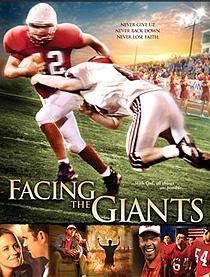


Facing the Giants is the story of Grant Taylor, a failing highschool football coach, who also happens to drive a junk car, live in a house that smells something fierce, and to top it all off, he and his wife are coping with the prospect of infertility. As his troubles begin to climax and his job and dreams are threatened, God teaches him important lessens that strengthen his, his team's, and ultimately the entire school's faith. The film explores the many ways that other characters are changed by the change in Grant's life as he puts his faith to work in his life and job.


First things first--here's the good.

Watching it is an enjoyable experience. It packs a powerful emotional punch, timing several parallel plotlines to climax and resolve in similar (albeit clichéd) fashion, at the same time. There was some profundity, enough humor, and the football action was surprisingly well done. The acting, although not polished, is good for two reason's: the language is spotless no matter how emotional some scenes got and still carried enough authenticity to pass muster.

The moral of the film can be summed up thus: Keep trusting in Christ, work in any calling as unto Him, giving him the praise for the results, and he will bless you, doing the impossible if need be. Do your best, leave the rest to God.

Some memorable lines:
"How can I miss someone so much when I haven't even met them?"
-Brooke Taylor

"You can't not make the team any more than if you don't try"
-Larry Childers
Facing the Giants provides a lot to chew on however. The most apparent problem is the one I alluded to at the top. This film preaches to the choir. While I don't pretend to think that God can't use a movie like this, it still is only going to appeal to a Christian audience. It was easy for me to get involved with the characters precisely because I could relate to them on a spiritual level. It just won't have that initial affect on a nonchristian. This just highlights for me that movies cannot take the place of the preaching of the gospel from the pulpit. I mean really, there are parts where the mini contemporary sermons make even me yawn.

There's another set of problems that form the basis for what annoyed me the most. Basically Giants takes hold and utilizes some of the favorite bad habits of the mainstream evangelical psyche.
First, while the film does everything to put the lack of Christ at the root of our culture's problems, it completely ignores the church's role in the process. The film portrays two communities--the family and the Christian school--so exclusively one would think the church didn't exist, or is needed for that matter.

The second "bad habit" comes when we see coach Taylor receiving an extra-biblical revelation from an eccentric man who every day walks the school halls praying for the children... "I just felt led to give you this message" is something I've heard countless times. Does this mean that people should just wait for their own little private revelations in order to get through tough times? To learn something from this film, must viewers hope they will just get that big break in the form of a prophet who can tell them verbatim what they should do? All I can say (with plenty of irony) is "good luck."

Third and finally, the turning point for the apathy-filled school ends up being a classic "revival." Students crying their eyes out, breaking up into spontaneous small groups all over the football field, kids dedicating themselves to Christ in the midst of a huge emotional upheaval. This tends to be the idealized pinnacle of gospel success in the minds of many ministers. Again, how realistic is this really? I won't deny any possibilities, but (excuse me while I become opinionated) beyond the fact that similar scenarios rarely appear except after the latest school shooting, I have always been very suspicious of such displays because real mindful "decisions for Christ" (to borrow a phrase that means nothing without regeneration) from kids aren't anymore likely under that kind of emotional stress than someone making the proper calculation in order to avoid a car accident based only on their emotional reaction to the scare.

So you've heard enough about what I think…with no spoilers I hope. If you enjoy football action, enjoy a feel-good movie or are just thankful to find a clean movie that doesn’t amount to Veggie-tales, by all means, go watch Facing the Giants.

Labels:

Sunday, September 10, 2006

Lady in the Water - part 2

I finally got around to seeing the WORLD review of Lady and was impressed by three specific aspects...two of which might be related--and they are as follows

First there's the fact that the writer enjoyed the movie and was positive, and second, that he didn't mention the now famous director at all--almost as if he wasn't familiar with any of Shyamalan's other work. I was at first shocked at the lack of mention (I dare you to find other more mainstream reviewers do the same) and the then happy as a lark because I finally found an insightful review that didn't try to contextualize it next to his previous works as if they needed to be linked somehow--as if directors of rare, anomalous movies need always repeat the past in some small way or die trying.

The review, by Harrison Scott Key,
called attention to one particular point that I think was alluded to on Jesse's blog--regarding the unorthodox character reactions to oddball events in the movie:
Whenever something completely weird happens in a realistic movie—like an alien lands or a ghost shows up at dinner—the audience generally needs one of two things. We either want a scientific explanation, or we want the hero to freak out and make us feel normal. So it's no surprise that an ashen young lady named Story (Bryce Dallas Howard) lives under the pool drain. The surprise comes when Cleveland Heep rescues her from an awesome beast, finds out she's a kind of sea nymph called a narf, and doesn't seem to think he's going nuts. What's going on here? This is Philadelphia, not Middle Earth.
Later he concisely argues for why this movie should work well for most:
Despite the fantastical nature of the work, our hero, Cleveland Heep, is about as round and real as they come. He is a flawed man who hurts, and he experiences a powerfully human moment of redemption and healing in the end. That's why you have to give yourself to the film. It takes faith to let art work on you. But if you let it, you'll be glad, in the end.

Labels:

Monday, August 07, 2006

Lady in the Water - is the jury in yet?

I had the opportunity of watching the movie under two different circumstances. The first time, it was with a more eager group of Shyamalan fans that perhaps weren't looking for a really scary movie. The second time was with a group that clearly expected to be scared and weren’t. As a result of this difference primarily, I think I enjoyed it the first time a lot more...

My perspective is a lot more balanced though as a result.

In a nutshell, I enjoyed watching it. It didn't take itself too seriously and was an interesting plot with very colorful characters to flesh it out. The acting was generally good and (as much as some seem to think otherwise) there were few, if any, loose ends.

There was one potential loose end that I didn’t end up putting together until the second viewing. It stuck out like a sore thumb until I was able to explain it. The point where the usually silent Mr. Leeds asks the question of Cleveland: “Does man deserve to be saved.”

Cleveland answers immediately in the affirmative, but is obviously confused. Is he, however, confused by Mr. Leeds’ question or by his own quick answer? It was probably the answer because that was supposed to be a clue to his identity in the story. His part (I’ll refrain from naming it) was supposed to be “full of hope.” The reason his affirmative answer should stick out to us is because by this time we know about his tragic past, and expect him to be despairing about the state of man.

Will anyone who's seen it be angry with me when I say that the best part in the whole movie was also the most morbid? (Mr. Farber's last part in the movie) I laughed plenty loud... I just found it to be such a perfect blend of self-conscious comic relief and also a vicious jab at anyone who thinks they know what should happen in any given story. To top it all off, I the outcome of that part actually surprise many people.

What was wrong:

To be quite honest, I think the worst acting came from the director--he didn't script his own lines very well, so his first major acting part in his own films ended up being somewhat flat. The sibling infighting wasn't very clever and sounded at some parts quite overdone.

Mr. Farber was somewhat more likable than he should have been considering his quick exit. I mean, while he was thoroughly cynical and arrogant as can be, he still admitted to enjoying the company of another resident and tried to help (albeit in ignorance and arrogance) Cleveland find what he needed. For the amount of screen time he got, that's pretty significant. But I shouldn't take this too far or I'll end up defending someone based on their extremely limited merits. Does anyone really deserve to survive any movie?

There is one other major complaint that I heard from a friend: He was upset that a seemingly good idea ended up being so poorly fleshed out. For example, he would have preferred that the myriad of trivial things in the movie had more significance and unity as in a classic McDonald or Lewis story. Not a bad thing to want I'm sure. But again, this movie doesn't take itself that seriously and at the same time comes in somewhat above par for the typical "bedtime story" of our day. Not long, but still was able to develop the interesting quirks of a large number of characters (he also complained about general poor scripting).

Any thoughts from the floor?

Labels:

Wednesday, July 19, 2006

Pirate thoughts - part 3

In the comment string for the last post, the question was asked: "Why can't you just enjoy the movie and not think about who the people are or what they do in real life?"

It's a good question. There's a sense in which I suppose you are right--that I would enjoy it a lot more if I didn't think in those terms--but consider this:

During the first movie, we asked Elizabeth's question "who's side is Jack on?" and come away with the vague answer in Will's line to Norrington, "but he's a good man." ok.

So the second movie comes out, and not only do we have the original (absurd) equation ultimately "proven": jack = pirate = good man... we also end up wondering what happened to our original lines between "bad" pirates and "good" pirates. Back came the original “bad guy” as the saving grace for Jack and the next film (or so we are to think).

I guess piracy (i.e. crime) is simply "freedom," if we understand Jack's philosophy correctly.

I'm just having a hard time working through all these atrocious conclusions all of the sudden. There's many more that come to mind.

Labels:

Sunday, July 16, 2006

Pirate thoughts - part 2

You know, it's almost amusing how often the realists get lumped in the bad-guy camp by Hollywood. Except for its ruthlessness and greed (lenses Hollywood never fails to use for corporate entities both past and present), the trading company basically made sense: "Jack Sparrow is a dying breed." Then later, Mr. Gibbs says that the trading company is "bad, very bad for every man jack what calls himself a pirate."

Duh!

I sometimes get weary of rooting for the ones who were really the most despicable people in real life? Even if the movie portrays them as lovable, funny and free, we always end up winking at they're consistent lack of conscience, unbounded lust, and pervasive self-interest.

Having said that, I'll probably be there to watch the third one when it comes out.

Labels:

Friday, July 14, 2006

Overboard: Pirates 2 review

With the dust finally settled on the stunning payoff numbers for Pirates of the Caribbean: Dead Man's Chest, I joined a large group of friends to see it last night in Burlington. The hype that has deservedly built up since the first one was released has just continued to amaze me. I watched The Curse of the Black Pearl with my brother Nathan pretty close to the opening week. Since we came away with the same side-splitting laughs and good natured thrills as the rest of the world, why wouldn't I go see the second production?

So how was the movie... (Are you ready for this?)

In summary:

I expressed to several different people before I saw the movie that the only reason I was going to watch it was for the pure entertainment value. It's what I got out of the first one and was all I could expect from this one. But pure entertainment value is exactly where the movie failed to deliver beyond a smorgasbord of special effects.

The problems, broken down
(mild spoilers)

The primary reason Pirates 2 failed where number 1 succeeded was the glaring lack of focus on any one thing or group of things. It was an exhausting marathon as a direct result. Not only are there more "main characters" than the movie can handle (most all carried over from the last movie, often with little to justify their presence), there is also an absurd number of just about everything else: villains (Jones, the company, and the natives), expendable ships and ship crews to get gratuitously annihilated (first Pearl crew, second Pearl crew, first merchant ship, second merchant ship, etc), objects of pursuit (compass, key, chest, heart, dirt, ship, etc)...and last but not least, twists to the plot--they came so thick and fast, I was wishing for the movie to end a half-hour early. It was complicated, full of loose ends, and the whole seemed to distract from any potential valuable plot points.

This movie tried to do too much...which brings me to my second point.

Point 2:

Dead Man's Chest was so full of little details and a myriad of surprises, it almost seemed self-consciously preoccupied with trying to out-do The Curse of the Black Pearl. Perhaps that's just the Disney influence shining through. Perhaps that's just a production company trying to capitalize on a proven market. Whatever the case, they tried TOO HARD. I'm sorry but the first movie was a good story, well crafted, and nicely closed--a movie that could stand on it's one story, plot, and cast without a figurative "to be continued" tag at the end like some moronic TV series. Now that a series of sequels is being pursued, it seems like all sense of closure is out the window. Not only are we left in a huge black hole of uncertainty regarding what's going to happen next, we also have no character development to help us understand what has transpired or what is to come for that matter.

I'm going to have to stop before I start the run-on sentence thing.

One final complaint (and to help illustrate my last point on character development):
-MAJOR SPOILER ALERT-

Commodore Norrington, the man so fondly remembered for his idealistic zeal to "see that all pirates get what's coming to them: a sort drop and a sudden stop," is one resuscitated character, having resigned his commission, and become a drunken brute of a man in the process, he presents a stark contrast (and a somewhat unbelievable one at that) to the previous version. Why this change. Perhaps we will never know, because the movie gave us no real depth of understanding to his character, and portrayed what was a huge, nonsensical transformation as just a point of humor and the convenient addition of an extra villain.

Why!!?

the end

Labels:

Monday, May 01, 2006

United 93 review

Note regarding recommendations:
I cannot take responsibility for what anyone else watches, or pretend like I know whether they will like something. I don't know whether you are worried about being traumatized--or whether you have a problem with watching something with and R rating...etc. For my part, I think it would do most people good to see it--just for the sake of remembrance. I can only say what I saw--what I wrote here is it.

***

An exam postponed, a study group canceled...there I was with an open Saturday evening with no desire or inclination to study it away in Bellingham. A thought struck me: Why not go see the movie, United 93. I got there just after it started for the 6:50 showing and tried in vain to relax in the seat. Nothing doing! There were at least two parts during the movie where I had to tell myself, almost out loud, to calm down. It's a very well-made film, however, with no embellishment—just a gritty sense of everyday realism. The soundtrack is minimal and many of the actors are playing themselves.

United 93 is an ideal story for a movie, not just because of the powerful subject matter and details, but also because the amount of speculation necessarily built into the plot is relatively minimal. After leaving the theater, I asked an employee what some of the reactions had been up to that point. He described two separate occasions where a male moviegoer left the theater following the movie, stood on the sidewalk and just screamed. I didn't observe anything close among the Saturday viewers, but, all things considered, I wasn't surprised in the slightest upon hearing this anecdote from the employee.

SPOILER ALERT BEYOND THIS POINT
Details for those who don't want to watch it.

Perhaps it's just in retrospect that I am starting grasp the raw power that is United 93. I didn't detect a Hollywood version of humanity among the people on the plane. They were normal, reacted with rage, horror, discord, unity and determination at appropriate moments. The two parts I mentioned above include the buildup to the initial take-over of the plane--the horror of the situation looms incredibly ominous and doesn't at all stop short of fulfilling the dread one feels just before it happens. The second spot is naturally at the climax...or rather the end, during the attempt to take the retake plane. With one single-engine rated elderly pilot on board, the passengers’ intention to subdue the terrorists and get this man to the controls before an inevitable ditch attempt, seems a staggering feat even before its commencement. That sequence of scenes is incredibly vicious and gripping. The director chose to portray a stiff defense by one of the hijackers in the first class cabin. The cockpit is also hotly contested, while throughout the struggle, the terrorist pilot (an extremely nervous character, who the movie implies might have ensured the hijackers’ successful crash into the capitol, if he had just commenced the takeover sooner) attempts to disrupt the passenger's efforts by erratic maneuvering...

At the conclusion, the passengers’ pilot is seated at one of the controls beside the terrorist. In the chaos, while two or three men attempt to restrain the man struggling to put the plane into the ground, the camera affords a fleeting view of the other man's hands struggling on the controls before the movie ends without ceremony as United flight 93 met her fate.

I included those details because I think they are important (for those who will not watch the movie for whatever reason) for understanding just how much this movie makes the viewer wish for a different outcome. The ill-fated effort to retake the cockpit will leave many with a hole in their hearts. I recognize just how much the producers could have risked if they had tried to embellish an already overwhelming story. This story isn't fiction, and could easily have developed a fictitious flavor if it had been tackled from any other angle. There was no need though—the story speaks for itself.

Labels:

Saturday, December 24, 2005

Narnia continued

NOTE: My good friend Jackie has written her highly anticipated critique of my review in the last post's comment string. Since I am set to leave town the day after Christmas, I found it needful to post my reply as quickly as possible. Thanks to all who have continued to share their thoughts on this landmark movie.

Jackie: You're going to think me supremely redundant after reading this through. To be honest, it's hard to know if you are sane when so many people disagree with you. But sane I am, for all I have tried to do is maintain my argument from the text of the book.
You say the movie did not "deliver in one essential area"- specifically, remain true to the original work. How so? Because you failed to see the Aslan of your own mental image? The book, "The Lion, Witch, Wardrobe" did not get any more in depth of Aslan's character than was portrayed in the movie. Lewis did leave further development for his character to extend over the other books.
The LWW isn’t all about Aslan’s character development. Agreed. If I failed to see Aslan according to my mental image, I would hope my mental image was from the book—or was your point that I shouldn’t have a mental image?
Lewis DID, I repeat DID, write the Narnia books as simply a child's fairy-tale. I believe you are looking for something profound and deep. Read Lewis' "Till we have faces" or "Mere Christianity" or even the Space Trilogy for that. Lewis had no intention of being profound in the Narnia books. He even said, in a letter to his friend J.R.R.Tolkien that the LWW story is simply a child's fantasy. He didn’t even seriously mean to write an allegory.
I’m sorry, but your belief that I am looking for something pretty “deep” (whatever that means) is just that: a belief. If you want to continue thinking thus, that’s cool. But for now, you're telling me that I think something and not addressing what I said. I don’t claim to be a scholar of Lewis’ and I’m only comparing a book and a movie.

One of your critisms I found quite contradictory. "He even goes so far as to ask Peter the rhetorical question, “You don’t believe in the prophecy?” as if that was a valid question." Right. That's why it was a RHETORICAL QUESTION. The point of the question was informing Peter that there's something bigger out there than his own plans or knowledge of his own existence.

The point of my criticism was more inline with a frustration with the over-blown idea of a “prophecy.” It struck me as being watered down. It staged a “Dune” kind of scenario in my mind, where the local people assume some foreigner has come to fulfill their prophecy and it takes some convincing for the person to accept his role in the story. Whether anyone else saw that or not (and I know you may have laughed at this point), it runs contrary to the spirit of the work. Aslan doesn’t need to do any convincing because the children come to KNOW what they are there for just by meeting Aslan. Don’t tell me you didn’t notice in the movie how there was a lot of emphasis on the “let’s just get Edmund, save Tumnus and go home” lines, even after meeting Aslan and going to battle!
You know what Lewis' basis of Aslan's character is. That is what you went to the movie looking to be obviously represented. But Lewis didnt write Aslan so clearly or obviously. The movie did not develop Aslan's character any less or more than this particular book did.

YES, and no. This is getting a little tricky because it seems like you are mixing the allegory and allusion to the gospel (something that’s just part of the plot) with the basic impression that I gleaned from the Aslan in the movie: this was my point. I most certainly did NOT go looking for Aslan to be “obvious” and easy to understand. Lewis didn’t make Aslan’s character explicit nor should he have. That’s just the problem with the movie. What you saw was what you had. Lewis was implicit and subtle. Aslan was someone you couldn’t probe fully except in the specific way HE chose to reveal himself.

Here’s where the dialogue before meeting him was so vitally important. It showed the animals’ incredible anticipation--which rubbed off on the children. Paradoxically, they had trouble articulating Aslan’s character so that the children could understand their anticipation. But that anticipation still hung with the children nonetheless and the movie completely missed that.
Lewis said himself in that letter to Tolkien. Those who understand any kind of allegorical reference that might be there, will 'get it.' Those who don’t, won’t. No more, no less. I believe the movie did just that. No more, no less. I believe you went looking for more, hoping that those
who didn’t 'get it' would. Since you understand the fullness of the Aslan's character, you were hoping to see the movie portray that. Yes, it would have been neat if they had, but in NOT doing that, they HAVE remained true to the book.
This is again, building up a lot of speculation about what I was hoping to see. Since I don't agree, I can only reiterate what I was looking for: the kind of reaction, effect, and anticipation I saw in the book, coming to life on the screen. There’s more to portraying Aslan by the book than what’s immediate—what he said, what he did--and those extras (see the quote at the end) are in the book and ARE needed. I'm not trying to impose a "complete picture" of Aslan on a story that doesn't reveal it. I didn't say that, so I'm intrigued to know what makes you think that? Are we speculating about my thought process or discussing what I wrote. I hate to say it, Jackie, but your critique of my review is more or less attempting to critique what you think I think. That’s perfectly fine if that’s what you want to do, but you may, as a result, grow tired of my equally persistent denials.
I also have to make a minor note on your critique of the soundtrack. Admit it, you were hoping for an epic soundtrack like that of LOTR. In actuality, Narnia is NOT an "epic" story like LOTR. It IS a children's fairy tale and the soundtrack, I thought, did MUCH to hold to that very idea. It was a soundtrack that matched perfectly with any children's fairy tale. Think Brothers Grimm here. I know Lewis did.
No, I will not admit anything of the kind about the music--and I'm thoroughly tired of having to talk about LOTR as though I am somehow too much a Tolkien fan to differentiate his work from Lewis. I have never entered a theater expecting any kind of music. Why bother watching a movie if you think there is only one right musical score or style, one right way of putting the dialogue together, etc.? A movie director is an artist with a tough job and that should be recognized. It would be arrogant to blow off a director’s choice of music without trying to understand it. I do understand your “Brothers Grimm” recommendation, but respectfully disagree that it ended up being of that caliber—mainly because “Brothers Grimm” tends to carry a different meaning for different people, all of whom have little to go on.

However, I know music can grow on the listener so I’m looking forward to watching it again soon with that in mind.

Thanks for putting the time into pursuing this. You can be sure I'm anticipating another response. I'm going to finish with a paragraph from the book that drives a lot of what you just read.
And now a very curious thing happened. None of the children knew who Aslan was any more than you do; but the moment the Beaver had spoken these words everyone felt quite different. Perhaps it has sometimes happened to you in a dream that someone says something which you don’t understand but in the dream it feels like it has some enormous meaning—either a terrifying one which turns the whole dream into a nightmare or else a lovely meaning too lovely to put into words, which makes the dream so beautiful that you remember it all your life and you are always wishing you could get into that dream again. It was like that now. At the name of Aslan each one of the children felt something jump in his inside. Edmund felt a sensation of mysterious horror. Peter felt suddenly brave and adventurous. Susan felt as if some delicious smell or delightful strain of music had just floated by her. And Lucy got the feeling you have when you wake up in the morning and realize that it is the beginning of the holidays or the beginning of summer.

Labels:

Sunday, December 11, 2005

Narnia review: Aslan the absent

Some in my acquaintance who will remember that, upon first viewing any of The Lord of the Rings movies, I did not support the idea of a movie about Narnia. I remember while reading the books once, thinking that I couldn’t imagine how someone could adapt it for a movie. Then I heard someone was seriously considering doing just that and I didn’t know what to think. I resolved to reserve judgment. Well, friends, the time for reservation is past.


What book?

Poor professor Lewis.

While it should be understood by all moviegoers that comparing the two would be like apples and oranges, The Lion, the Witch, and the Wardrobe, failed to deliver in one essential area where The Lord of the Rings succeeded: It did not remain true to the venerable author’s original work.

Exhibit one is unfortunately the tragedy that is Aslan’s portrayal. Compared to the books, the movie makes him into a tame lion. Most readers who saw it might be puzzled by my assertion because of the way the movie ended with Mr. Tumnus’ statement about tame lions and how Aslan was no such thing. Its presence was gratifying but unfortunately seems to replace the lines that should have been said in the beaver lodge. In the book, the question is posed: “Is he safe?” The emphatic “no…but he is good,” in answer is enough to make readers extremely eager to understand Aslan, to meet him, to probe his character. Peter voices this in the book at that point, carrying the reader with him in his excitement: “I’m longing to see him, even if I do feel frightened when it comes to the point.”

In the movie, the Tumnus line is just simply, “he’s not a tame lion, you know…” It didn’t really have any impact except to put a definition on what you already saw, which, quite frankly, was just a talking lion king who killed the witch.


Driven to distraction

It’s quite possible that my negative impression of the movie goes beyond what I consider inadequacies. I’m sure I was more than a little distracted by trivial things like the horrific soundtrack. I was thankful for the times I didn’t notice it. Otherwise I felt like plugging my ears when this or that voice in the music kept trying to take center stage over the visuals.

The good stuff

On the bright side, the animals were awesome. Honestly, if special effects can contribute to the over-all success of a movie, this is the case study. The casting and acting was well done too. The children were just as they should look and feel—although poorly directed many times, causing them too much awkwardness at important moments…like the stone table for example.

Another bright note was the battle scene. More specifically, I appreciated the centaur’s breathtaking moves when he killed the enemy general and challenged Jadis. The children are green at that point and not a little awkward (as it should be), which makes it a little hard to watch sometimes—I expected that, though.

What is left to the imagination in the book tended to find good rendering throughout the movie. All the different fighting styles of so many animals were beautifully choreographed. The witch’s house was dazzling, dark and gave me the creeps—you are left wondering how Edmond can be such a dunce as to think he has a friend in this place.

So that’s a skimming of my thoughts. Yes, I cannot emphasize enough my disappointment over Aslan’s shallow portrayal. One of the most striking evidences is the first conversation he has with Peter. Aslan does nothing to indicate he has any kind of omniscience—you get the idea that He doesn’t know Peter well at all—not where he came from, not what he needs to hear. He even goes so far as to ask Peter the rhetorical question, “You don’t believe in the prophecy?” as if that was a valid question. In the book, Aslan tells Peter that he and his siblings will rule in Cair Paravel and the matter is settled. Peter didn’t respond in protest.


I’m so sorry Professor Lewis. I had hoped people would grow closer to your masterpiece through this movie. I think they will only find themselves more confused. So what is the movie’s point now? If you are looking for a vague allegory of a biblical story as you would in a Veggietales parody, then by all means, this movie is for you—a childish story and nothing more.

Labels:

Sunday, July 03, 2005

'Batman' and Straw Man (spoiler alert)

A couple weeks ago, I had the pleasure of watching Batman Begins and I must say, I thoroughly enjoyed it. The acting was great. The effects were great and there was originality throughout. Granted, the music was unimpressive, contributing little beyond dark bombasticity--which is disappointing, since I heard Howard Shore and Hans Zimmer collaborated to compose it. It's one of the few movies from which I've come away without recalling one memorable bar.

But there's plenty more to say, as became evident when my friends and I left the theater and had a "parking lot philosophy" discussion about some of the themes which turned us to capital punishment and similar topics. I decided I needed to explore some of my negative reactions to the movie and the way it deals with the issues we discussed.

First of all, there's the portrayal of bad guy Liam Neesen's character. The taste left in my mouth is not just a fantastical bad guy striving with a clear conscience for the destruction of a city. I see also a bad guy who is simply striving, according to the film maker's view, toward what is the logical conclusion of a conservative (Texan? Cowboy?) sense of justice. Let me just say that the early introduction to Liam Neesen's character made me want to stand up and cheer. Quotes like, "criminals thrive off the understanding of society" really animated my sense of justice and got me initially on his side. I was impressed.

Perhaps my surprise when our hero turns his back on him was not the intended emotion of the director. At a scene where it is a simple matter of executing a murderer, our hero suddenly starts insisting on a litany of extra hurdles like a full-blown trial.

Now before I get too far along, there is no doubt that--looking at the big picture--the "league of shadows" is a twisted bunch. They have a huge self-importance complex, along with a Godless philosophy. Also, my judgment of Bruce's insistence on refusing the "executioner role" changes when he is back in Western society (explanation farther down). But I can't ignore the minor fact that the bad guys look, at one point, like Lockean purists. Is this just an accident? I don't know. If it isn't, I can't help but think the director has painted a picture that initially looks like what I saw (the Lockean purist) and then makes the case that there is only one logical conclusion to that way of thinking (the twisted blow-up-cities conclusion).

Finally, if I were to pick apart the specific situation facing Bruce at his botched initiation into the "league," I would have to say he made the wrong decision. Here's why:

His primary argument against following through seems to be about due process. With all due respect to due process, I must say this is an admirable impulse--albeit misplaced. For here he is in the middle of nowhere (the Himalayas!) with the closest thing to established government being the league he is joining--what kind of due process can he expect? I'm reminded of a memorable John Wayne quote from The Green Berets: "Out here, due process is a bullet." Even more importantly, I'm reminded of John Locke when he says in his Second Treatise of Government:
And thus it is, that every man, in the state of nature*, has the power to kill a murderer, both to deter others from doing the like injury, which no reparation can compensate...(*Note: Locke's state of nature is one with no government, where the laws of nature, and I would add, nature's God, are the only rule, and all men are free, equal, and independent within the bounds of the law of nature.)...and also to secure men from the attempts of a criminal, who having renounced reason, the common rule and measure God hath given to mankind, hath by the unjust violence and slaughter he hath committed upon one, declared war against all mankind; and therefore may be destroyed as a lion or a tiger, one of those wild savage beasts, with whom men can have no society nor security: And upon this is grounded the great law of nature, "Whoso sheddeth mans blood, by man shall his blood be shed." And Cain was so fully convinced that everyone had a right to destroy such a criminal, that after the murder of his brother, he cries out, "Every one that findeth me shall slay me;" so plain was it writ in the hearts of all mankind.

If someone has any doubts about how influential was Locke's thinking on our founding documents, especially the Declaration of Independence, just let them read the complete Second Treatise and the Declaration and see if they can come away thinking Locke was just a crock.

I don't have the knowledge or credibility to claim the 'Batman' directors tried to denigrate Lockean justice using a Straw Man argument. So for now I guess I'll just be content with pointing you to the potantial.

I'm sure Robin will replace Straw Man as the sidekick in the next one.

Labels:

Tuesday, February 15, 2005

Subtle images of life

How much are you affected by the music you hear or the movies you enjoy? For myself, I don't know. A good chunk of America now thinks Mr. Dobson from Focus on the Family condemns SpoungBob SquarePants as somehow pro-homosexual in nature. I don't think that has ever been Mr. Dobson's point as he makes clear in this fairly comprehensive piece, but neither is that what I want to talk about.

For those who do believe (like me) in some intrinsic influence of media on our personal views, negative or possitive, I think we would do well to recognize some movies and songs that slip under the ACLU, Planned Parenthood and NOW radar and could have some small influence on the public perception toward abortion.

***

Movie: "The Forgotten"
When it was released last fall, it didn't make a big splash but neither was it a big flop. The plot had a lot of potential but disappointing many people who wished it could have developed into the psychological thriller they expected.

Without going into too much detail, let me just say that the climax of the movie depends on one woman's ability to remember "the life that was in her" before the birth of her son. It was something I didn't really notice in the context of a prolife message at first until a friend pointed it out. It made the movie a little more worth seeing in hindsight.

Song: "My Name"
(Artist: George Canyon)

George Canyon is new to the country music stage, and even though he's a Canadian, he seems to do very well for himself on both sides of the border. Some of his first and recent singles include "A Good Day to Ride" and "I'll Never Do Better Than You." Over all, I've been very impressed with him and so far have never been disappointed with his product.

This time, though, I'm stunned. His new song "My Name" is the touching story of the tragedy and heartbreak of a miscarriage, told through the eyes of the unborn child. I heard it first a couple weeks ago and today I finally went online and watched the music video. It's just as moving as the music. At the end of the video they give the website of The Compassionate Friends, a national organization dedicated to helping bereaved parents. I've done a little reading from their site and I did not find any information on abortion. That said, I'm glad Mr. Canyon chose to honor bereaved parents with a story about an unborn child. By doing so, he really hit hard where it matters.

If you get the chance, listen to this song--I dare you not to cry.

***

Let's hope these images have the impact they deserve. Ultimately, I don't think there can be true healing without the gospel--something that is often missed in our zeal to staunch the tide of abortion. Yet, even so, it certainly can't do any harm to give Mr. Canyon's song its proper due.

Labels: ,